Nine thousand parts, one crown
Garage De Coninck in Destelbergen takes Toyotas apart and sells the parts on — probably the largest independent Toyota parts dealer in Belgium. We built the trilingual catalogue of almost ten thousand pages, and the app that gets a part from the warehouse shelf onto the web.
Visit toyotaonderdelen.be
Dendermondesteenweg 800, Destelbergen. Outside stand the Toyotas that have driven their last mile; inside, their parts sit on shelves: Yaris, Corolla, Avensis, Hilux, a Landcruiser, the odd classic. Garage De Coninck has been doing this for decades and is probably the largest independent supplier of Toyota parts in Belgium. Mr De Coninck knows that warehouse the way other people know their living room.
What was missing was a decent way to get all of it online. The previous site ran on WordPress with WooCommerce, and what exactly was on the shelves lived in a hundred-odd Excel files. Since early 2022 things run differently.

Welcome to my playground
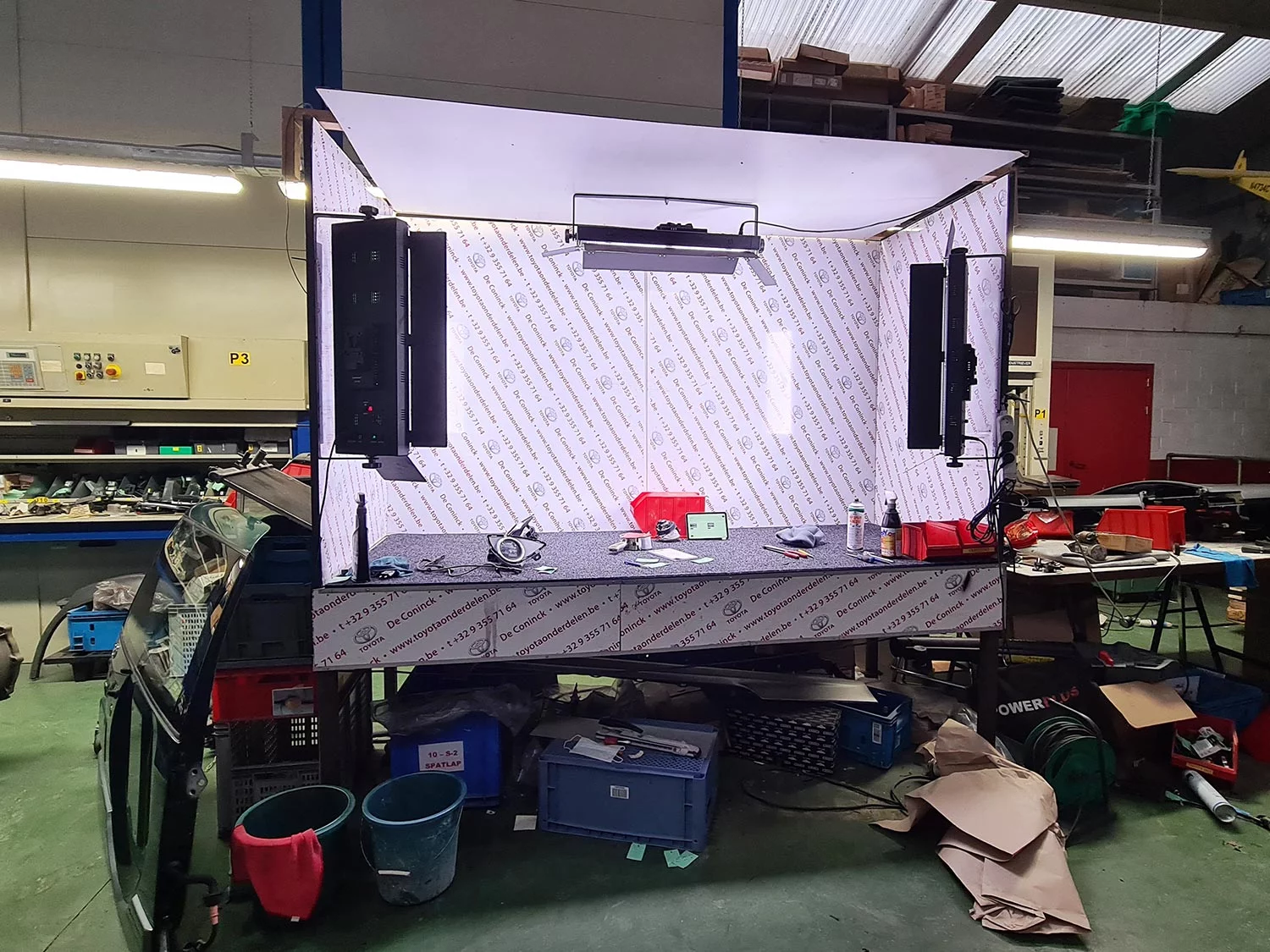
That was Mr De Coninck introducing his photo studio. It sits right in the middle of the warehouse: a table, two lamps, a softbox and wallpaper he had printed himself, covered in Toyota logos, his web address and his phone number. Every part that comes off a car passes through it.
You’ll spot that wallpaper on almost every product photo on the site. Advertising that prints itself, thousands of times over, with nobody to maintain it.
One screen instead of a hundred files
Cars come in every week, and a part that isn’t in the catalogue doesn’t exist. So there’s an iPad next to that studio. In the app you pick the part type and fill in the rest: article number, shelf location, stock, weight, length, width, height, condition, the mileage of the car it came out of, the warranty, the engine type, and whether the thing was made in Japan, France, Turkey or the UK. Then four photos. And off it goes, into the catalogue.
No walk back to the office, no detour through a spreadsheet. The columns that used to be spread over a hundred and six files now sit in a single form.

Print me
At the bottom of that form sits a yellow button: Print mij. A card printer hangs off it. One tap and out rolls a coloured card with the article number, the model, the name of the part, its place on the shelf and a barcode. That card goes back into the racks, with the part itself.
Handy in the warehouse, but the best bit shows up online: on the product photos, the card is simply lying there. What you see on screen is literally the one item on that shelf.
To make those iPads work everywhere between the racks, we hung up wifi repeaters. They deal in hardware; so do we, occasionally.

Nine thousand pages, and still finding things
The catalogue is built like the warehouse. Model first: 29 Toyotas plus a drawer marked “other models”. Then the build years, because a Yaris ’05-’11 (P9) is not a 2022 Yaris Cross. Only then the part. If you know what you need, you filter by type: driveshaft, ABS pump, catalytic converter, window mechanism, seat belts — a good fifty of them.
If you don’t, you just type. “Alternator” returns 107 results across every model. Each page shows the photos, the article number, the dimensions and the weight, because a driveshaft of 12 kilos and 1.25 metres still has to get somewhere.
All of it in Dutch, French and English. The sitemap holds 12,839 addresses. We knew the principle: every item is unique, every item gets its own page — same as with Sanderus’ 500-year-old maps.


From cart to quote
People have ordered from this catalogue online: the webshop ran here, cart and all. Today a product page carries no price but a button reading request a quote. The business is in a period of transition, and while that lasts, everything goes through a request.
For second-hand parts that is no disaster: every item is a one-off, with its own condition, its own mileage and its own shipping cost — you don’t send a mirror cap the way you send a gearbox. Ordering all the way through to behind the counter is something we do build: at Ceres Orders the chain runs end to end.
The crown
The admin sits behind a login screen, and there is nothing sober about its logo. It’s the Toyota emblem, with a golden crown on top. The one place in the world where the king meets himself every morning before typing his password.

King Gaby
Mr De Coninck is the kind of client you want. He knows what he wants, he laughs at his own playground, and he’d rather call than email. We got to move his ageing setup to something that actually grows with him, and we had far too much fun doing it.
At the bottom of every page on his site it still says “launched by Major Tom”. Four years on, it’s still there. And there are still cars on the parking lot.

Related work
Other work that connects to this.


Gone faster than the horses
Web app →