
One map, one copy
On the Nederkouter in Ghent, maps five hundred years old sit waiting on the shelves. Of every single one there is exactly one. We built the webshop, the invoicing tool and the intranet the Devroe family runs it all from — the last one, at their express request, in bright green vintage.
Visit sanderusmaps.com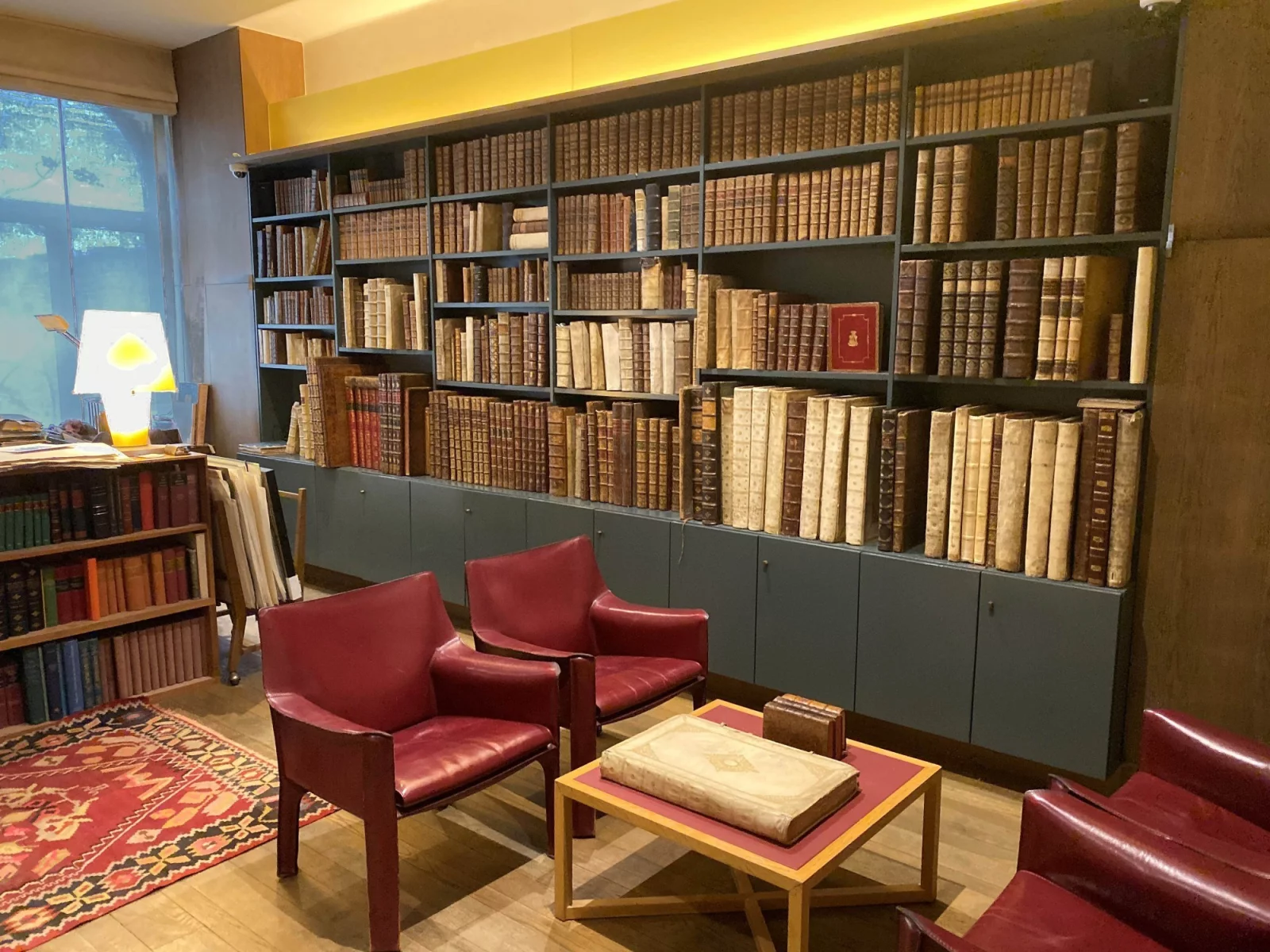
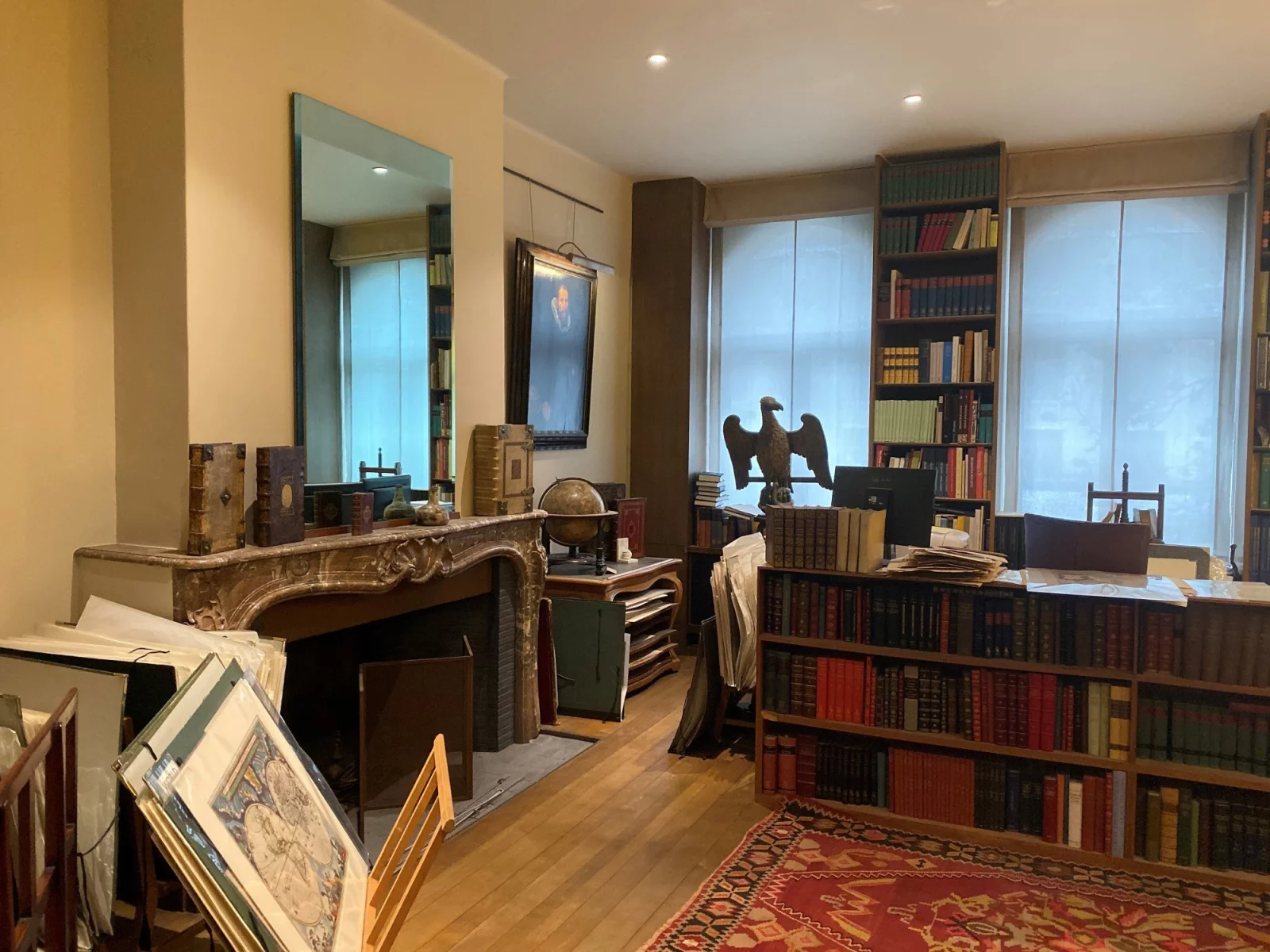
Antiquariaat Sanderus sells antique maps, sea charts, prints, illustrated books and medieval manuscripts from the 15th to the 18th century. Filip Devroe started the business in 1980, first in Kortrijk, and since 1993 on the Nederkouter in Ghent. His son Brecht joined in 2002, Dieter in 2003. They are members of the Antiquarian Booksellers’ Association and of the Belgian Chamber of Antique Dealers, and they exhibit at international map and book fairs.
What is online today runs from € 250 for a Westphalian regional map to € 42,000 for a Leo Hollandicus of 1648. A client of ours since 2014. In 2018 we started on the software.
The database first, the shop second
In the summer of 2018 we drew the data model before anything else: items, mapmakers, categories with sub-levels, standard texts per publisher, properties (medium, type, orientation, condition rating), lots, fairs, reference works, orders, and a single exchange rate. The plan back then was still a migration to WordPress and WooCommerce.
It didn’t end up that way, and just as well. An antiquarian bookshop fits no standard shop model. There is no stock, no size M, no second copy. There is one map, and it is lying in a drawer on the Nederkouter.
An invoice that knows what an antiquarian sells
We started with the bookkeeping rather than the shop. Invoicely, Harvest, Invoicera: fine tools, right up to the moment you need an invoice for a 1596 map under the margin scheme, shipped to a customer in Switzerland. There is always that one box missing.
So in 2019 we built our own. At the top of the invoice: number, invoice or credit note, the customer record, paid or unpaid, invoice date, shipping date, due date. Below that the VAT choice, which does the real work: 0, 6 or 21 per cent, 0% outside the EU, 0% intra-community supply, 0% margin scheme. Per line you pick whether the amount you type includes or excludes VAT; the rest works itself out.
To the right of the lines, the invoice takes shape while you type. At the bottom you choose the language of the PDF — English, Français or Nederlands — and it leaves with a mail template in that same language. One screen, no export, no second programme.

The shop: a catalogue that falls out of the database
On 31 January 2020 the first order came in at sanderusmaps.com. The site runs on Kirby — designed and built by us — but the products are not pages. They exist only in the shop’s own database — the very table in which Brecht and Dieter keep their maps. Every product page is assembled on the spot from that row.
Which means nobody has to enter a map twice. One tick box — OpWeb — and the piece is online, with its description, its dimensions, its condition and its references. The catalogue itself has four main groups (maps, books, medieval manuscripts, prints) with dozens of subdivisions: Europe alone covers Belgium, the Low Countries, France, Germany, Italy, the British Isles, Greece and a long row of others.

Searching the way a collector searches
A collector doesn’t search for “old map France”. He searches for the engraver’s name, for one word from the title, or for the item number printed in a catalogue ten years ago. Which is why the advanced search has four separate fields: title, mapmaker, keywords and item number, plus the category. Sorting goes by title, mapmaker or price. Type nothing but a number and you land straight on that one piece.
Every map also carries a condition rating from A+ to D, an authenticity guarantee and a row of bibliographic references that link through to the reference library on the site. That last part isn’t decoration: in this trade, the reference to the standard work is the proof.
Three currencies, set by hand
Every price appears in euro, dollar and pound at once: € 6,200 ($ 7,068 / £ 5,270). No rate feed, no subscription to a financial API. The intranet has two fields, USD and GBP, and there they set the rate they want to work with. A customer in Los Angeles knows where he stands, and the shop knows no cent slips away on a Sunday-night currency jump.

One copy, and then it’s gone
This is what sets it apart from every other shop we have built. There is no “only 3 left”. There is no re-order. When a map is sold — in the shop, at a fair or online — the dealer ticks it in the record, and the piece leaves the catalogue. No ghost page stays behind; the search results simply count one less.
Internally the map lives on, with its date of sale and the price it actually fetched. Hence the gap between the 5,076 pieces online today and a numbering that has passed 33,000. The database is the memory of the business; the webshop is the window display.

Checking out
The basket runs in three steps. Payment by credit card through Stripe or by bank transfer. VAT is decided per country — each country carries its rate and whether it sits inside the EU — and there are discount codes, shipping costs and free shipping above € 990. After the order the confirmation mails go out; the admin holds an overview of all web orders with printable order documents to go in the parcel.
There is also a Pay online page: name, e-mail, amount, pay. Handy for an invoice, or for a piece agreed on at a fair, without a web order in sight.

The green screen
In 2021 came the question we like best: “could you move our old application to a new computer?” That application was a thirty-year-old Visual Basic program. Moving it was no longer on the table. What was: giving everything inside it a new home, on the same database as the webshop, in the browser.
And then the styling. Explicitly requested: keep it as it was. So we drew it light green, with black and hot pink buttons, a strip along the top holding the last opened item numbers as tabs, and a fixed bar at the bottom that turns orange the moment something is unsaved. Not a single design trend from 2021 has ever touched this screen. It works beautifully.
Each map carries some forty fields: number, mapmaker, region and area, title and imprint, sale price and purchase price, inventory date, sold and date of sale, cartographer, engraver, atlas, type, lot, coloured, orientation, condition and condition rating, medium, language, height and width in millimetres, owner, bibliographic references, internal notes, three kinds of dates, the OpWeb tick box, two web texts and a label. Images are dragged straight in, recto and verso.

Import base text. Generate.
Two buttons save the most time here. Importeer basistekst lets you pick the publisher and drops the standard text about that atlas into the record — because the hundredth map from the same atlas deserves the same introduction, not a hundred rounds of the same typing. And Genereer assembles the English web description out of the separate fields: title, dating, technique, dimensions, verso, condition, rating, references, provenance. What goes underneath is still the dealer’s own words; the dull part writes itself.
Elsewhere on the dashboard: an overview of the maps, most recently added, most recently viewed, base texts, mapmakers, reference works, lots, coupons, the web orders, Pay online — and the labels. Those are gathered into a list and printed: the little cards that sit next to the pieces in the shop and on the fair stand.

backtogroen
The site’s code contains an admin plugin literally named backtogroen — “back to green”: one button that takes you from the modern Kirby Panel straight back to the green screen. That’s how it goes with good habits.
What it does today
The catalogue is updated every week: the newest pieces carry numbers above 33,000, the latest images are from this month. More than five years after launch the shop still runs on the same principle. One database, one tick box, one copy.
More of this kind of work: the corporate site and webshop of Mercatorfonds, the ordering module behind the pharmacy counter at Ceres Orders, and the gallery with its own webshop at Footnote Gallery.
At the bottom of sanderusmaps.com it still says “launched by Major Tom”. It can stay there.
Related work
Other work that connects to this.


Experience your garden with Livingreen
→
