
A wave that imitates the mountains

Rain on titanium
It was raining while we were there. Frank Gehry’s Guggenheim opened in 1997 and is clad in 33,000 titanium plates; in our photographs the square is wet and two people walk past under an umbrella.
On the square in front stands Maman by Louise Bourgeois, nine metres of bronze from 2001. A spider with a sac of eggs beneath her belly, intended as a tribute to her mother — a weaver.

The same woman a hundred and fifty times
Inside hangs One Hundred and Fifty Multicolored Marilyns, which Andy Warhol made in 1979. Over ten metres wide — 201 by 1,055 centimetres. It is the same silkscreen, a hundred and fifty times side by side, in different colours each time.
That idea — one fixed procedure, and variation within it — simply hangs here on a wall. The work belongs to Warhol’s Retrospectives and Reversals, in which he takes up his own earlier images and reverses them — hence these dark, negative-looking Marilyns. Repetition that does not go dull.

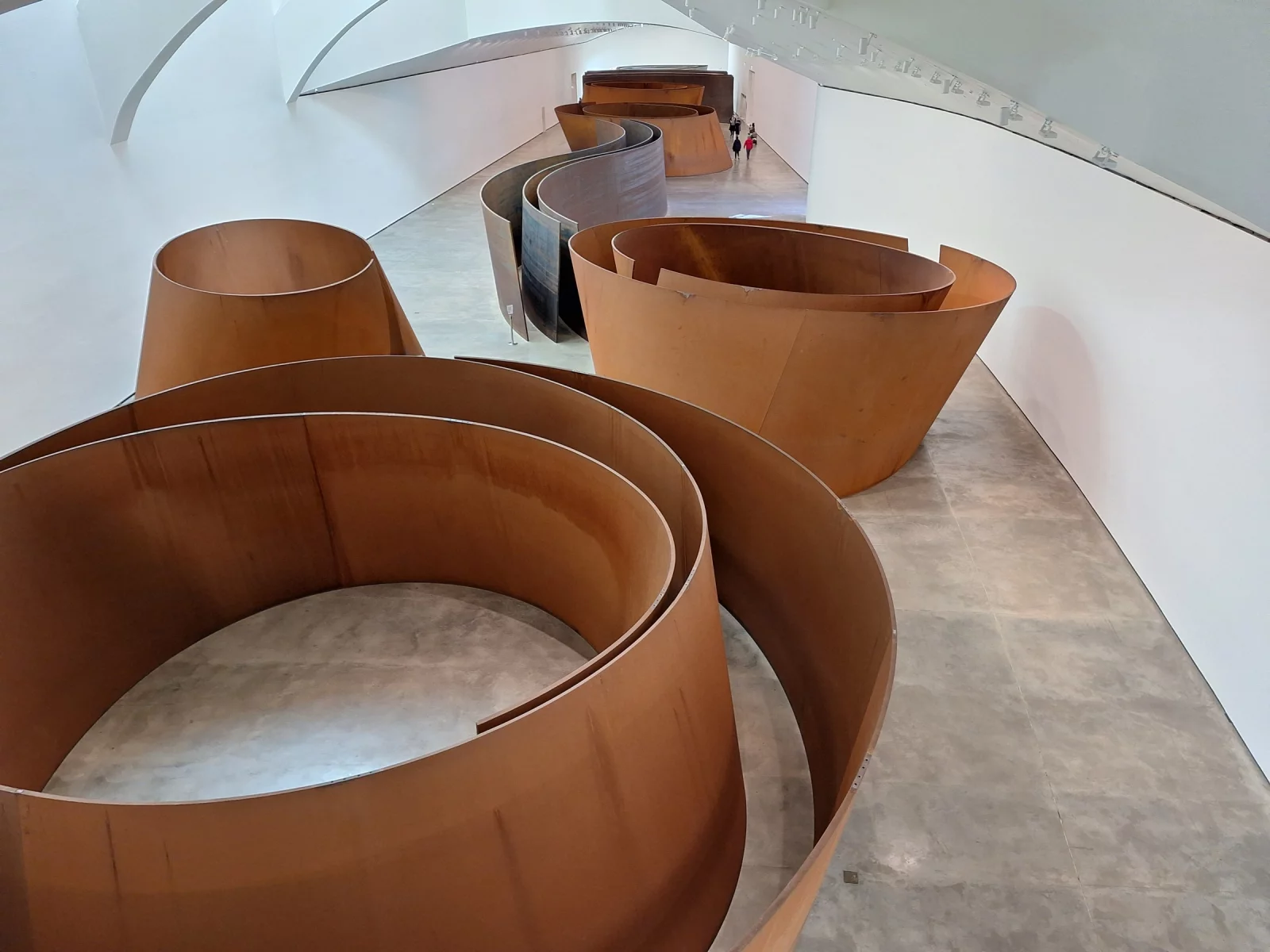
In the same museum stands its only permanent work: The Matter of Time by Richard Serra, in a gallery 130 metres long. Weathering steel, in spirals you walk through. You never see the shape as a whole — you have to walk it, just as at La Tourette.
The bar
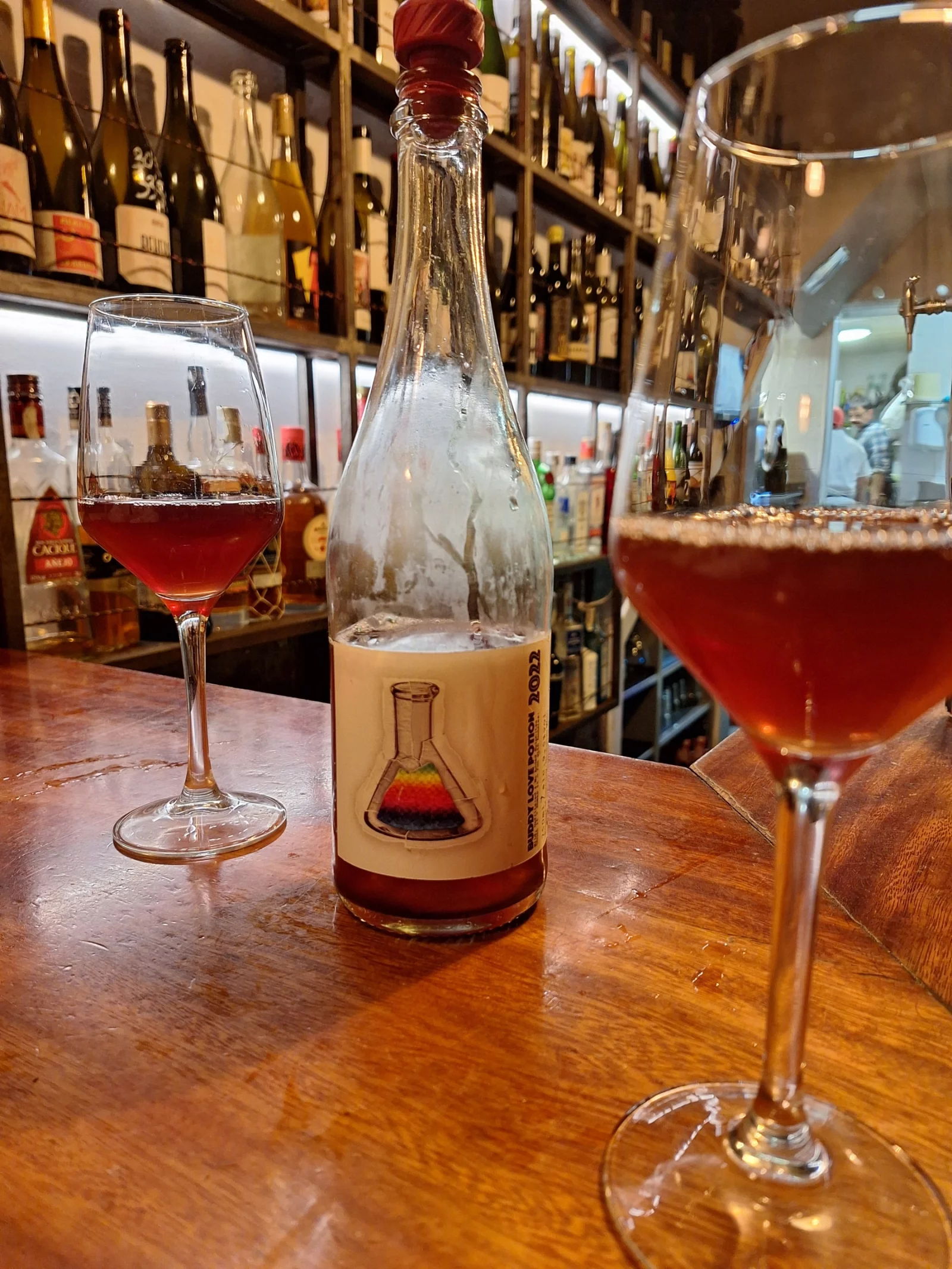
In the evening, natural wine at a bar in town. A wall of bottles with the price chalked onto the glass. You do not pick one yourself: they ask what kind of wine you like, and then a bottle arrives that fits — explained as it is poured.
Two glasses of orange wine and a plate of pintxos on the bar.

At that bar sat someone who was drawing. While we drank, he drew us — two heads, watercolour, with “SALUD” and “LET’S ROCK” in speech bubbles.
And then a bottle appeared on the table with an astronaut on the label. Petite Folie, a Spanish red: a small figure in a red spacesuit, a bottle in one hand and a glass in the other. For a studio called Major Tom whose system is called Ground Control, that is no longer wine but a calling card.


Calatrava’s bodega
Two days later we drove into the Rioja Alavesa, to Bodegas Ysios near Laguardia — a winery Santiago Calatrava built in 2001. Two load-bearing concrete walls 196 metres long and 26 metres apart, tracing a wave in plan as well as in elevation. The south façade is clad in horizontal cedar slats that are reflected in the pool like a row of barrels lying on their sides.

But you only understand the building from further away. That wave is not a whim: it runs along the foot of the Sierra de Cantabria and repeats the back of the mountains behind it.
Which is the same move as Le Corbusier’s, only inverted: he measured the human being, Calatrava measures the landscape. In both cases the form comes from somewhere.

What we took away
Three buildings, three ways of doing the same thing. Gehry lets the form go and holds on to the material. Calatrava takes his form from the horizon. Warhol holds on to the image and lets go only of the colour.
That last one stays with you longest. We build websites, not buildings and not paintings — but one fixed procedure you can keep varying within, without it going dull, is exactly the problem we deal with every day.