
Cycling across an island that no longer exists
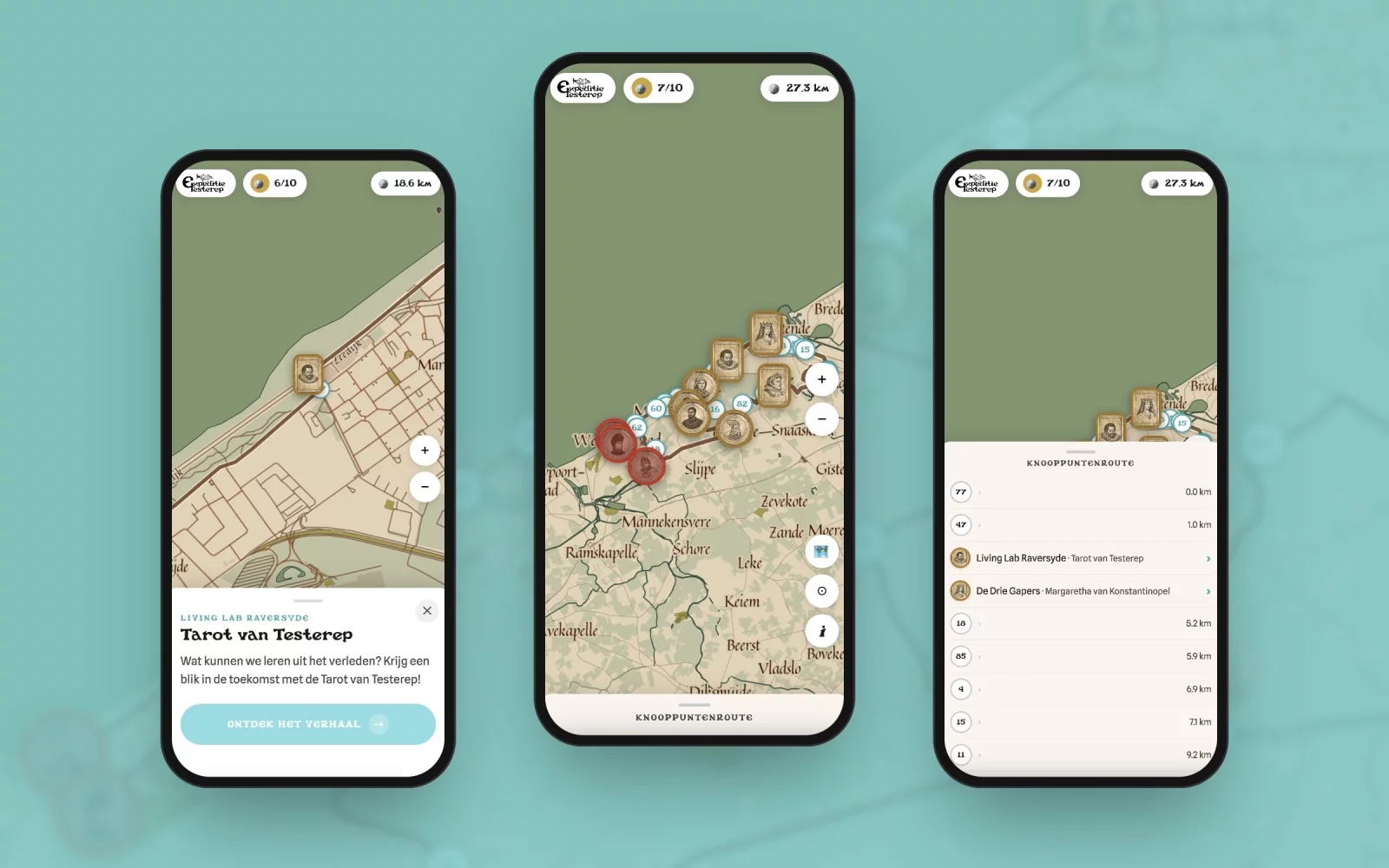
Once, between Ostend and Nieuwpoort, there was an island: Testerep. The sea took it back; we put it back. On your phone, along a 42.8-kilometre cycling route, with ten coins, four languages and a tarot game that predicts your future. Or at least the coastline’s.
Join the expedition
Some stories you read. Others you ride.
Expeditie Testerep is a heritage cycling route along the place where the island of Testerep once lay, between Ostend and Nieuwpoort. The sea, storm floods and centuries of dyke building and land reclamation wiped it off the map. What remains are stories. And those stories needed a bike, a map and a phone.
The concept, the stories, the illustrations and the films come from Pièce Montée and Little Harry. We brought it all to life as a web app: multilingual, fast, and built for someone with one hand on the handlebars and the other on their phone. (Please don’t do that last bit. Hop off for a moment.)
Testerep on TV
Rather experience it from the sofa first? In Het Provinciaal Domein on Focus-WTV, Vincenzo cycles through the vanished island of Testerep, meeting historical figures, medieval fishermen and a coastline that never sits still along the way. Broadcast on 10 September 2026.
Watch the report on focus-wtv.be (in Dutch) →
A cyclist, a phone and an island that no longer exists. Good television, as it turns out.
Ten coins, ten stories
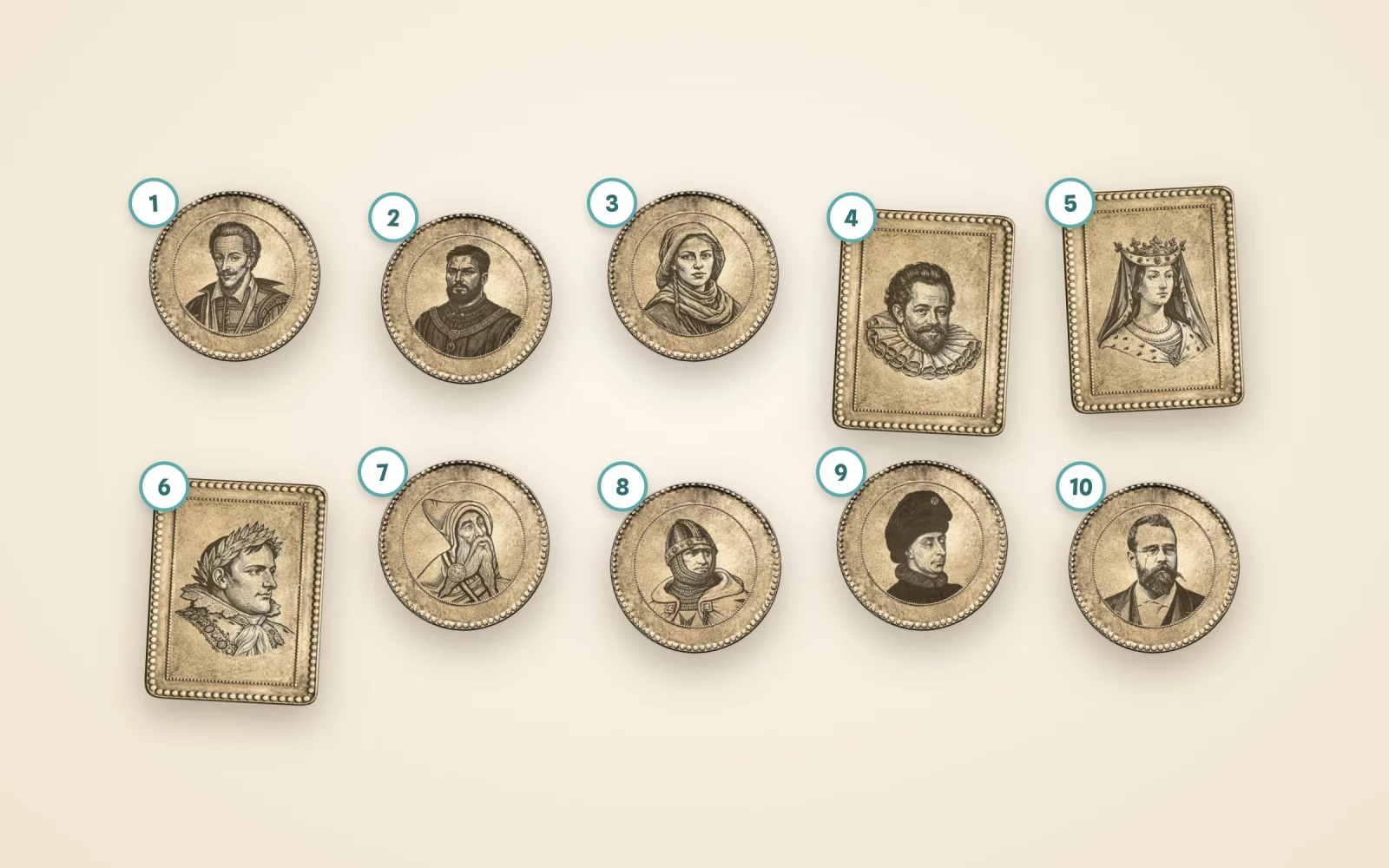
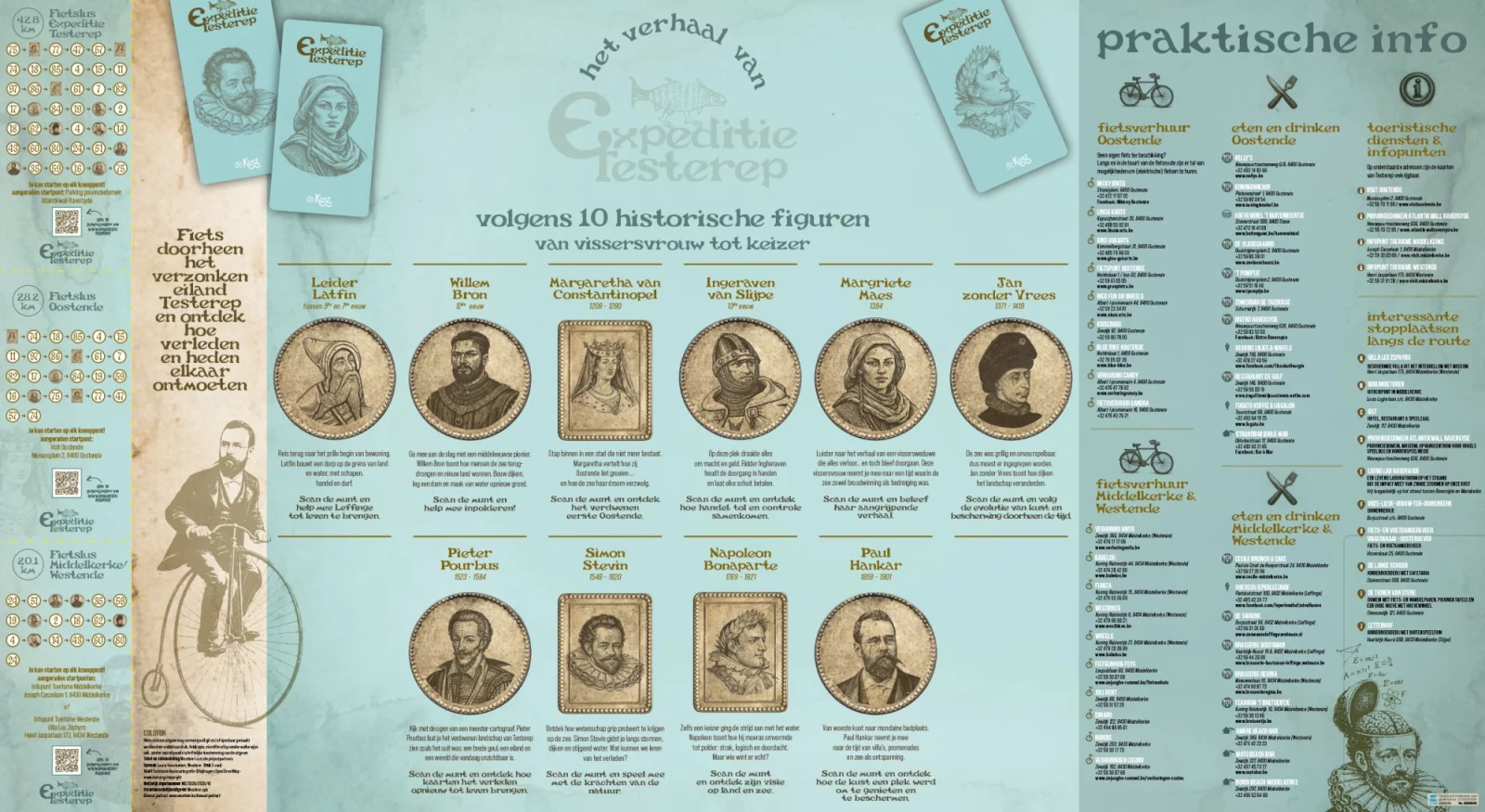
The route has ten stops. At each one, a coin with a QR code is waiting, and behind every coin is a character who tells their own piece of Testerep’s story. A selection from the cast:
Pieter Pourbus, cartographer, shows you what the island once looked like. He mapped the coast in 1571, so he should know.
Willem Bron turns up with a spade and a plan: reclaim the land.
Margriete Maes, a fisherwoman from Walraversyde, has known nothing but the sea her whole life.
Napoleon. Yes, that Napoleon. He had a polder built in Stene.
Sir Ingheraven van Slijpe guards the trade route between Ypres and Bruges. Not for free.
Paul Hankar dreamed of a fashionable seaside resort in Westende. He just hadn’t reckoned with the sea.
Also on the bill: Latfin and his clan, Margaret of Constantinople, John the Fearless and a tarot game. More on that shortly.
Five ways to tell a story
Not every story fits the same format. A cartographer tells a tale differently from a knight, let alone a tarot game. So we built five content formats, all in the same app and in four languages.
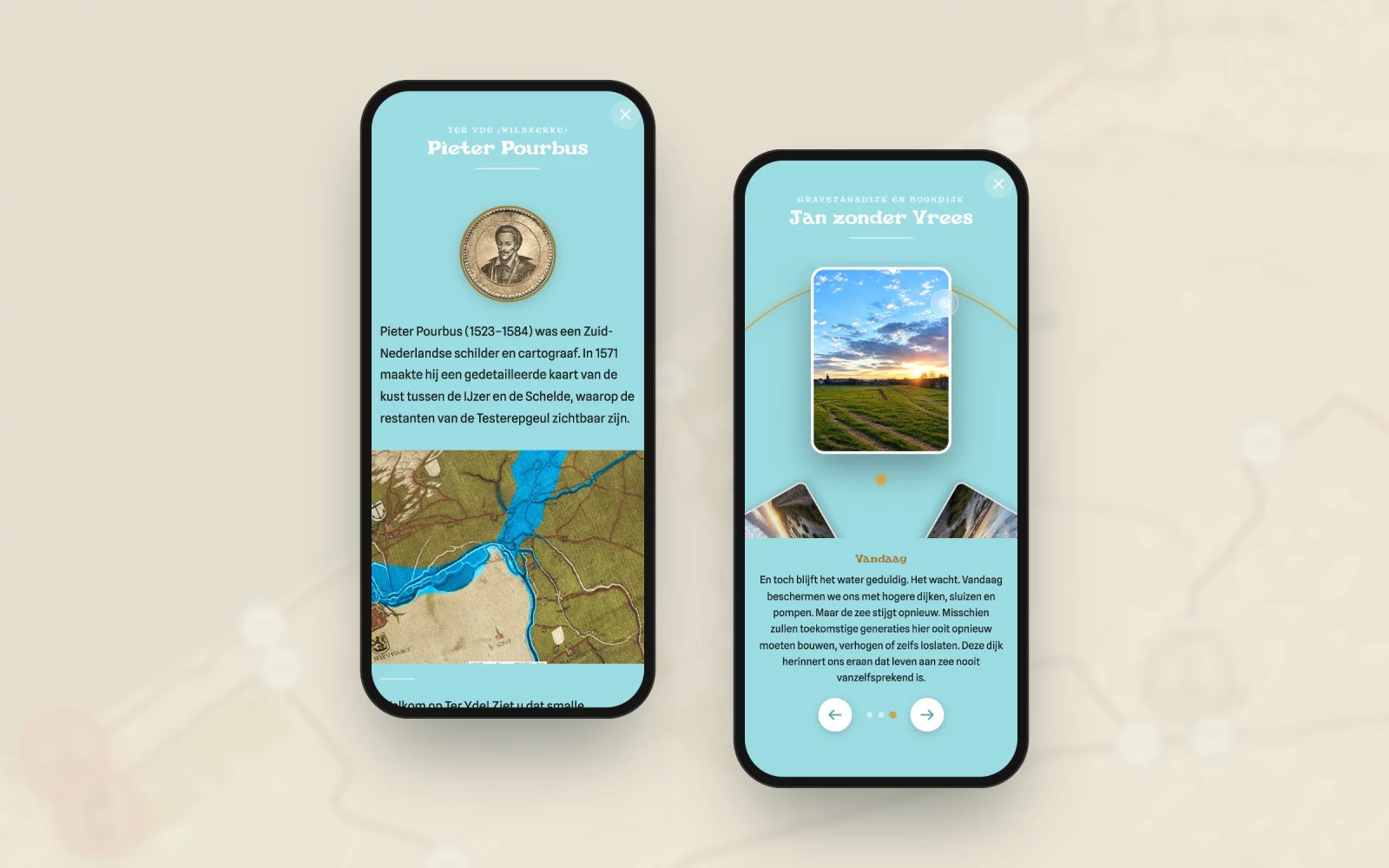
Reading and browsing. Text with historical images and maps, and a viewmaster that lets you flick through the centuries with your thumb: from before the fifteenth century to today.
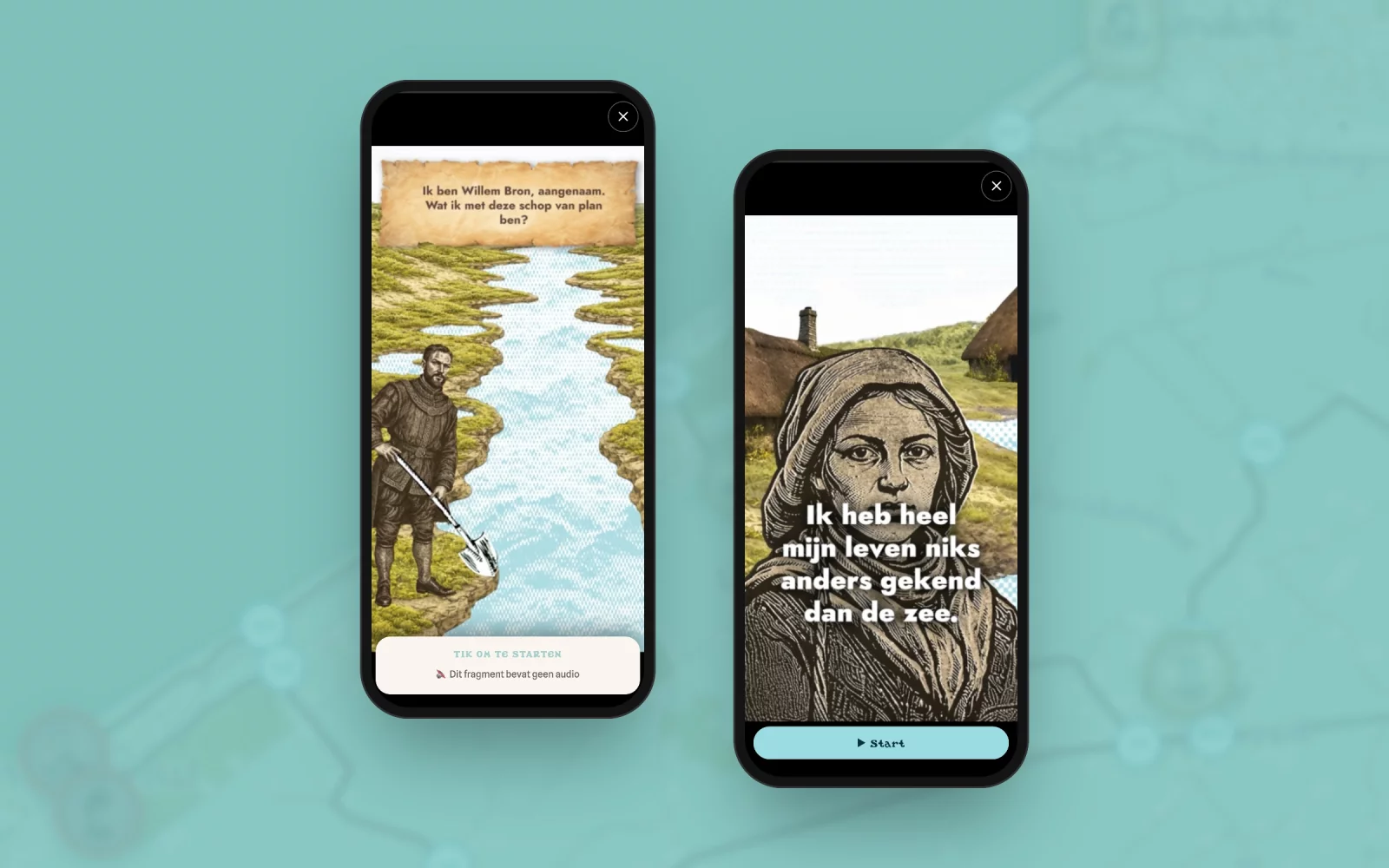
Tap-through stories and listening. Animated films pause at exactly the right moment, so the cyclist decides when the story continues. One tap and Willem Bron picks up his spade again. In the audio and video stories, the characters speak to you directly.
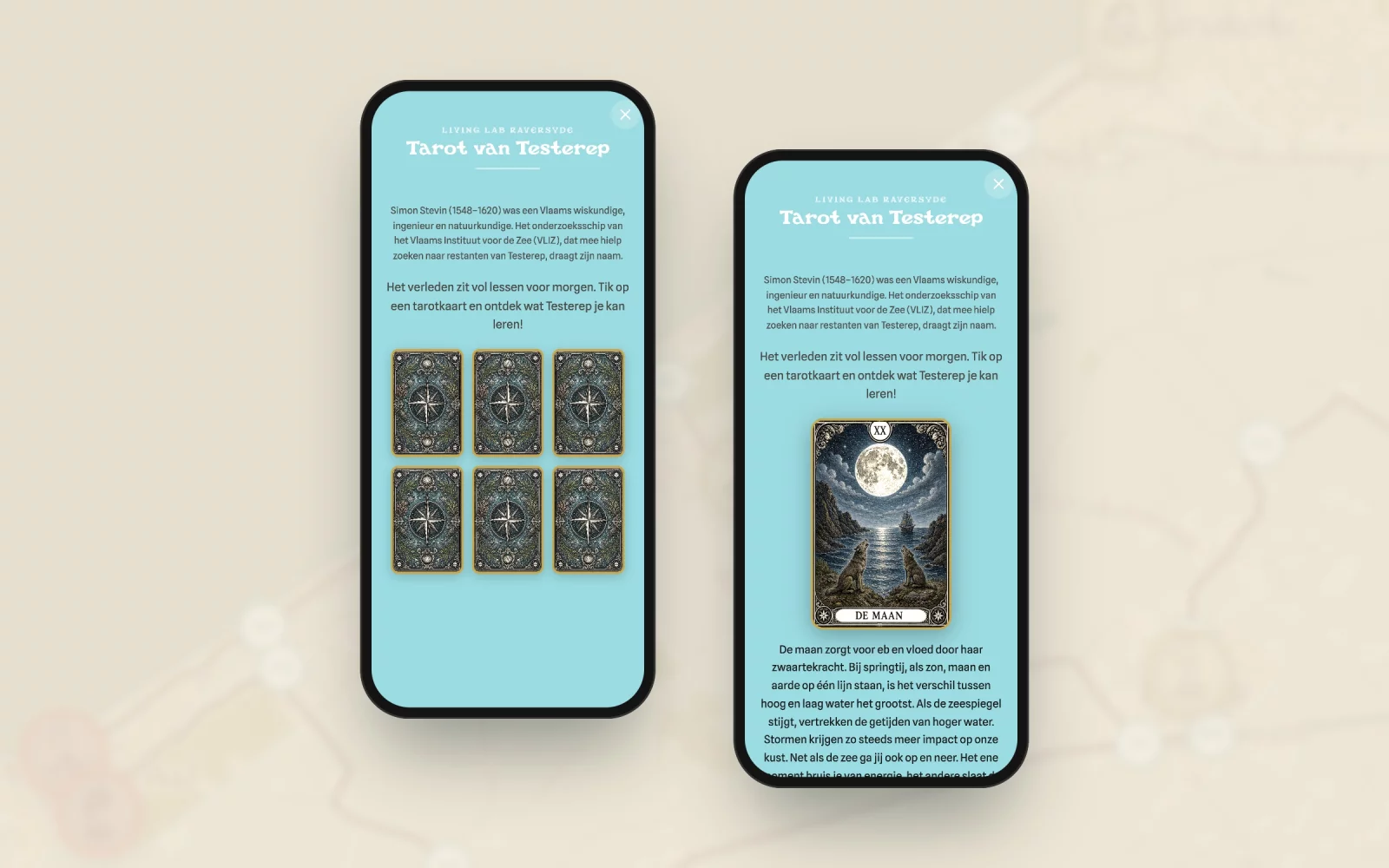
A glimpse of the future. At the Living Lab Raversyde, you draw a card from the Tarot of Testerep. The Seabed, The Dyke, The Moon, The Wind, The Sea or The Flood: each card reveals what the past teaches us about the coast of tomorrow. A fortune teller who brings up sea-level rise. We didn’t see that one coming either.
Behind the scenes
The technology never tries to steal the show here. It needs to appear when it’s needed and then vanish again, just like the island itself. Behind that simplicity, though, there’s quite a bit of puzzling.
Four languages, four tempos. Every film exists in Dutch, English, French and German. The tap-through films have to pause at exactly the right moment, but what takes twelve seconds in Dutch takes, well, nun mal vierzehn in German. So every stop got its own timecodes per language.
Sound on an iPhone. An iPhone only plays sound once you tap it yourself, and that tap has to be tied directly to the film. Sounds logical, until you build an app that starts the intro film after a language choice. We put more coffee into it than we care to admit.
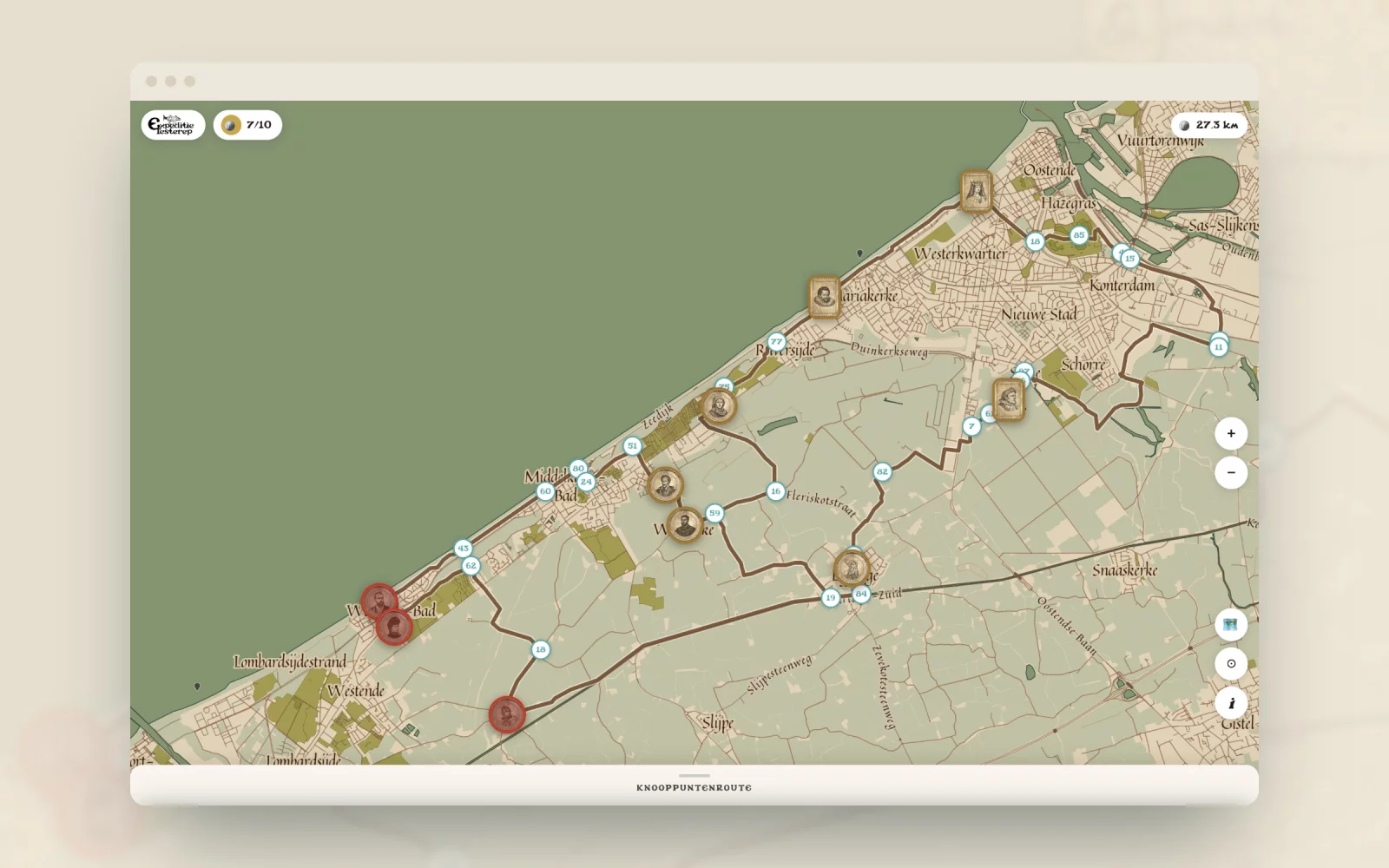
The right place, the right moment. Scan the QR code at a coin and the app opens the right story straight away. GPS shows where you are and counts the kilometres; the cycle route tells you where you’re heading. You can start anywhere: the story begins wherever you do.
No cookies, no login, no tracking. The app only remembers, on your own device, which coins you’ve already found. Who’s out there cycling, we don’t know. Exactly as requested.
At home on dekust.be. The app stands on its own, but also lives full-screen on the De Kust website. On a large screen you see the entire route at a glance, handy for planning your trip at home.
Paper works too
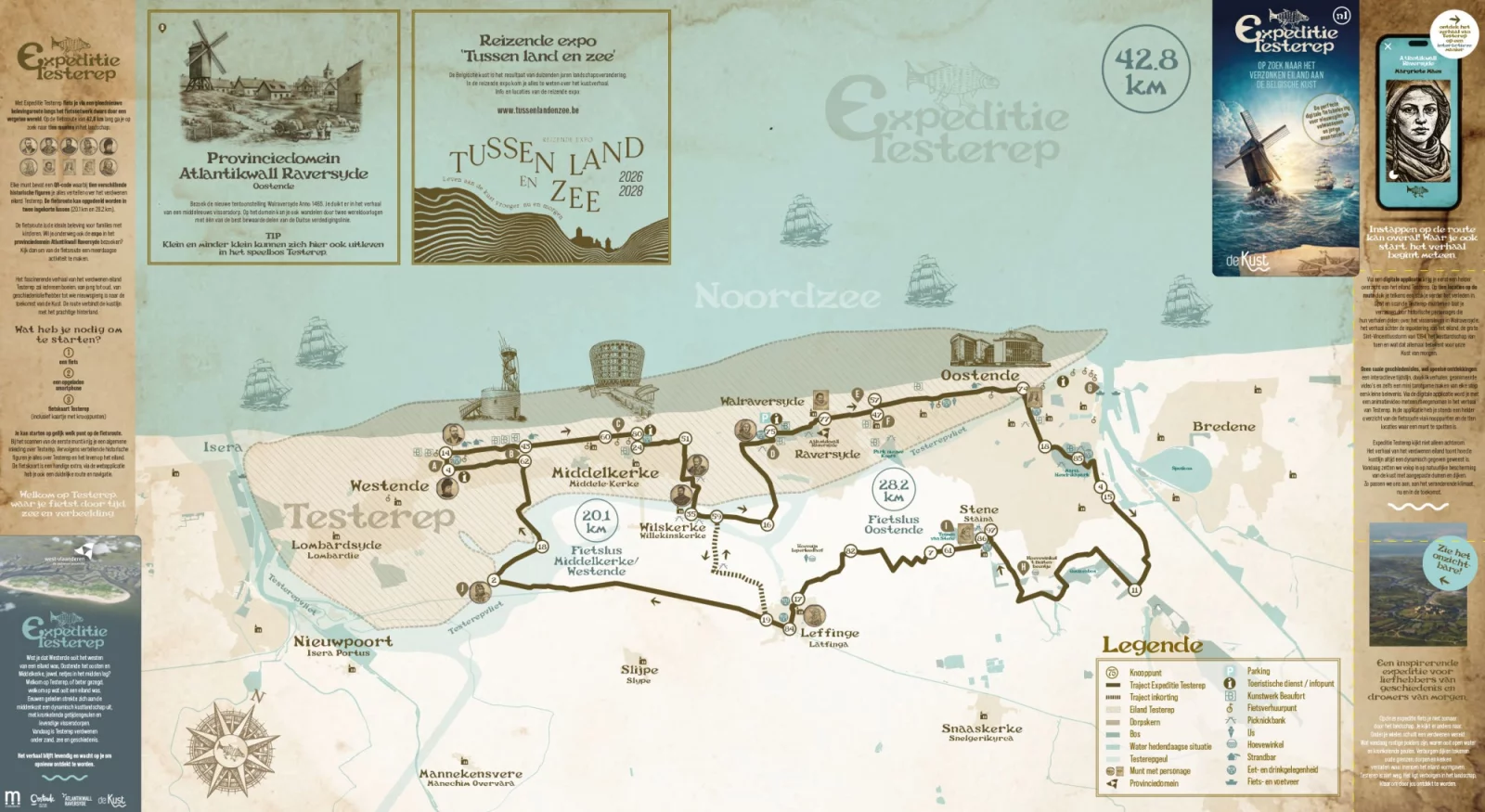
The app comes with a cycling map showing the full 42.8-kilometre route and two shorter loops of 20.1 and 28.2 kilometres. For anyone saving their battery, or who simply enjoys folding maps.
A great collaboration
This project is teamwork in the best sense of the word. Pièce Montée and Little Harry dreamed up the expedition and created the stories, the illustrations and the films. We made sure all that beauty actually works: on a phone, in the sun, with half a bar of 4G, somewhere between Leffinge and Stene.
Short lines, plenty of enthusiasm and a shared love of detail. We’ve worked with Pièce Montée before, and it remains a pleasure. On to the next expedition.
What we delivered
Technical development of the complete web app, based on the design by Pièce Montée and Little Harry
Four languages: Dutch, English, French and German
Interactive map with ten coins, GPS location, distance counter and cycle route
QR codes that open the right story instantly
Five content formats: text and images, viewmaster, tap-through films, audio and video stories, and a tarot game
24 films in four languages, with timecodes per language
No cookies, no login, no tracking
Embedded full-screen on dekust.be
Hosting and follow-up
ImmoGolf
Naming, branding & website →
